Hatha yoga in Chennai for a working week
Most people who walk into our hall in New Perungalathur are not after a workout. They have a desk job, a commute up the GST Road, a stiff lower back and five or six hours of sleep. Hatha yoga suits that life, and this is how we teach it.
What hatha yoga actually is
Hatha is the branch of yoga almost everyone in India has already met, named or not. It is three things practised in order: asana, the postures; pranayama, the breathing; and relaxation. Postures are held rather than rushed, the breath sets the pace, and the class finishes lying still instead of out of breath.
That is the shape of every batch at our centre in Chennai — warm-up, asanas, pranayama, relaxation. Not because it is fashionable, but because it is the version a person can do at half past five in the morning, five days a week, for years, without being an athlete to begin with.
Be clear about what it is not. Hatha is not a heated room, not a fast flow you chase for forty minutes, not a class you are expected to keep up with. If you have stayed away from yoga classes in Chennai because the ones you saw looked like a gym session set to music, this is the other thing.
Why it suits a Chennai working week
Chennai hands a body a specific set of problems, and they are not the ones a generic fitness plan is built for.
The heat. For most of the year this city does not need your core temperature raised further. A practice that holds postures and lengthens the breath leaves you steady rather than wrung out — which matters with a full working day still ahead. Hence batches at either end of the day: early morning, before the heat, and five in the evening, after it.
- The commute. An hour on a two-wheeler or standing in a suburban train carriage, five days a week, tightens the hip flexors and shortens the front of the body. Hip openers and spinal movement answer that directly.
- The desk. Screen work rounds the upper back and pushes the head forward. Standing postures and back-bends such as cobra work against that pattern rather than around it. Low-back and neck pain are the areas where theevidence for yoga is strongest, though how much it helps varies from person to person.
- The sleep. Pranayama and the closing relaxation are what students most often say changed something: better sleep and less stiffness within two or three weeks of practising regularly. That is our students talking, not a study — though theUS National Center for Complementary and Integrative Health, which reviews the research, reports that yoga may help with sleep and with stress.
None of this is unique to yoga — walking and swimming are good for you too. What hatha adds is that the breathing and the stillness are inside the hour, not something you are told to do later at home, which nobody does.
What an hour in the hall contains
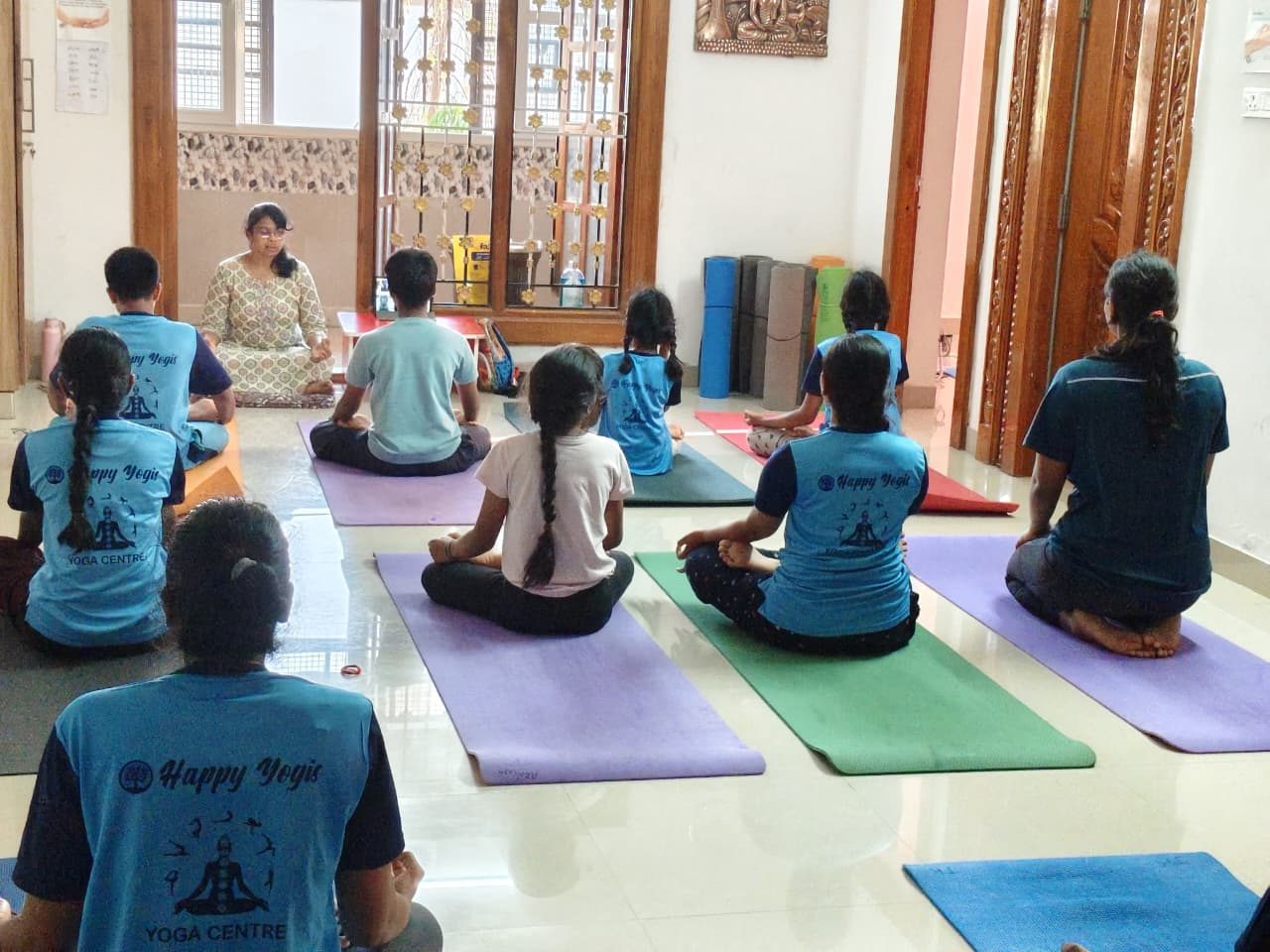
The batches are mixed. On a normal morning school children, people on their way to an office, homemakers and retired members share the mats, all doing the same practice at whatever depth their body gives that day.
- Warm-up. Joint rotations and gentle stretches, usually including cat-and-cow through the spine. Nothing in this part asks for any flexibility at all.
- Asanas. Standing postures such as tree pose, forward folds, downward dog, cobra and seated twists. When the practice is built around stamina it runs through sun salutations instead.
- Pranayama. Seated breathing practice. Several students arrived for the postures and now say this is the part they would not skip.
- Relaxation. A few minutes lying still at the end. It is not padding; it is where the practice settles.
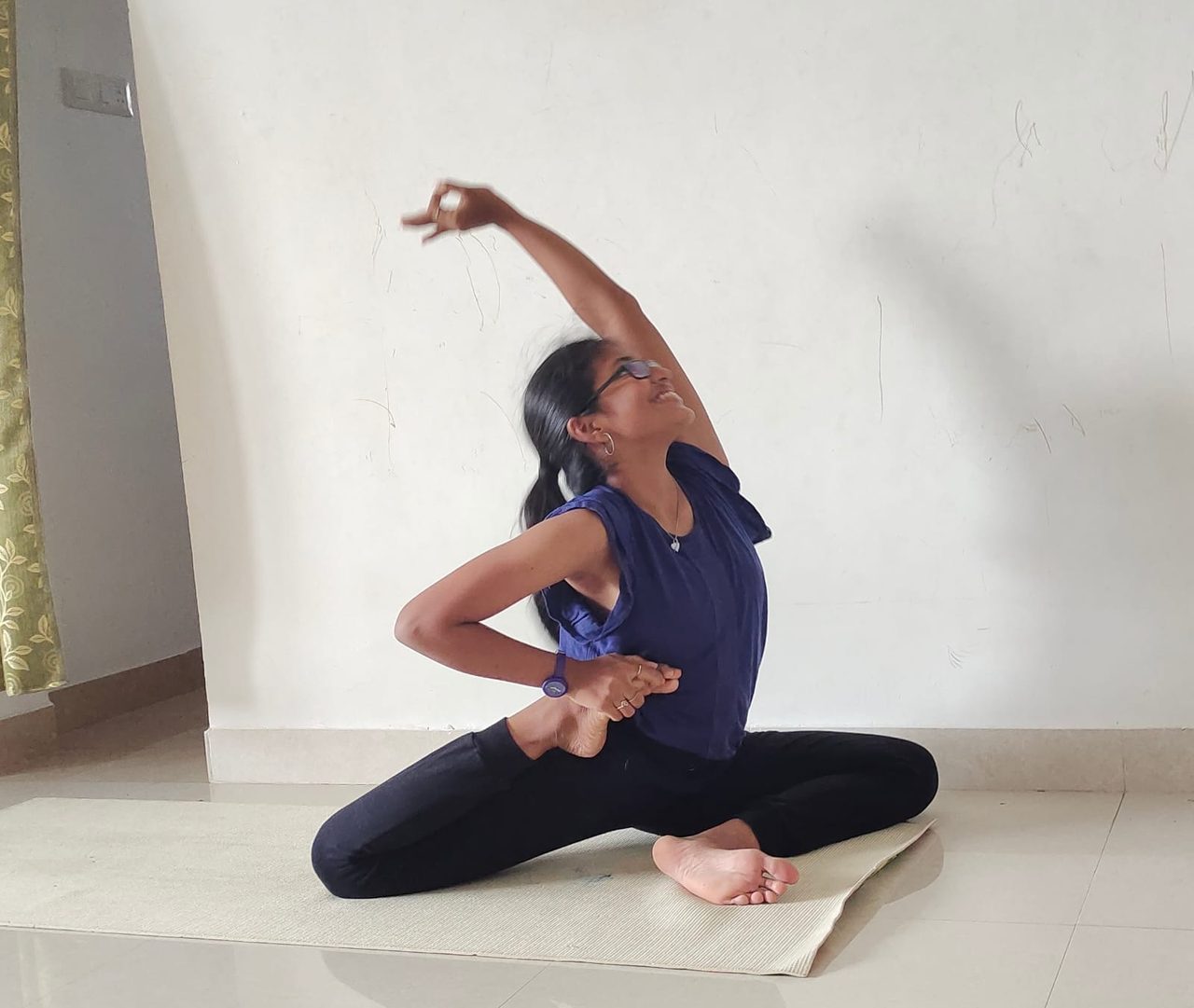
Karthika takes every batch herself and has practised and taught for more than ten years. Batches stay small enough that she knows what each person is working with — the whole reason the practice can be adapted rather than simply delivered.
Choosing a batch around your day
There are four batches, Monday to Friday. Which one is right is usually decided by your commute rather than by your yoga.
- 5:30 – 6:15 am, 45 minutes. The short early batch, for people who have to be out of the house first.
- 6:15 – 7:15 am, 60 minutes. The busiest hour, and where most beginners start.
- 10:00 – 11:00 am, 60 minutes, ladies only. Mid-morning, after the school run and before the afternoon.
- 5:00 – 6:00 pm, 60 minutes. The evening batch, for anyone whose mornings are not negotiable.
We also teach the same practice online, and students move between online and in-person as their week allows — useful in a city where one bad evening on the road costs you an hour. You can see which batch is next on the schedule on the homepage, and there is a 3-day trial so you can sit in before deciding anything.
Practising around what you arrive with
A good number of students come to us because a doctor suggested it. The practice is planned around the condition rather than in spite of it.
- PCOD and hormonal health, sequenced at a manageable pace
- Thyroid support, through breathing and chosen movement
- Knee and joint pain, worked low-impact and with support
- Back and spine — posture correction and spinal strengthening, the most common request we get from desk workers
- Pregnancy care, guided and adjusted by stage
- Stress and sleep, for students who arrive wound up
Tell us before your first class so the teacher can plan around it. And to be plain: yoga supports treatment, it does not replace it. If you are under medical care, keep your doctor in the loop.
Taught in Tamil and in English
Instructions come in whichever language the batch is comfortable with, Tamil or English — how a hall in Chennai with three generations on the mats has to work. Children practise alongside their parents in the morning and evening batches, not in a separate class. Families arrive together, and the practice is old enough in Tamil Nadu that somebody's grandmother in the room usually knows what pranayama is without being told.
Every student is given a Happy Yogis t-shirt, and once you join you can leave your mat at the centre instead of carrying it in every day.
Where we are, and who travels in
We teach from a single hall in SSM Nagar, New Perungalathur — just off the GST Road stretch between Tambaram and Vandalur, close to Perungalathur railway station. No other branches, no franchise: one centre, one teacher.
Students travel in from Old Perungalathur, East and West Tambaram, Selaiyur, Chromepet, Vandalur, Urapakkam, Guduvanchery and Medavakkam. If you are looking for yoga classes in Perungalathur or a yoga centre near Tambaram, those two pages cover getting here from either side. Anyone further out, or with an unpredictable week, takes the same batches online.
Questions people ask before they start
- Do I need to be flexible?
- No, and it is the most common worry we hear. Most people who join cannot touch their toes on day one. Flexibility is what the practice builds; it is not what it asks for.
- Is hatha yoga enough on its own?
- For mobility, posture, breathing and sleep, it does the work. If your goal is specifically losing weight, the faster sun-salutation practice is taught inside the regular batches — there is no separate course to book.
- Which batch should a complete beginner join?
- Any of them. Every batch is mixed ability and the practice is adjusted person by person. Most beginners pick the 6:15 am or the 5:00 pm batch.
- Can men join?
- Yes. The 5:30 am, 6:15 am and 5:00 pm batches are for everyone. The 10:00 am batch is women only.
- What happens if I miss a week?
- You pick it up again. Nobody is behind, because the practice is adapted to the person rather than run as a syllabus.
Where to start
If you have read this far, the useful next step is not more reading. Come to one class, at whichever of the four times you could keep to, and see what an hour of hatha yoga does to a Chennai working day. The 3-day trial exists for that.
Come and try a batch
Four batches a day, Monday to Friday, at our centre in New Perungalathur.